
PRx Bumper Plates Review
Updated September 2026 with my 6-month review · First tested July 2025 · 3 videos
My score: 4.5 out of 5
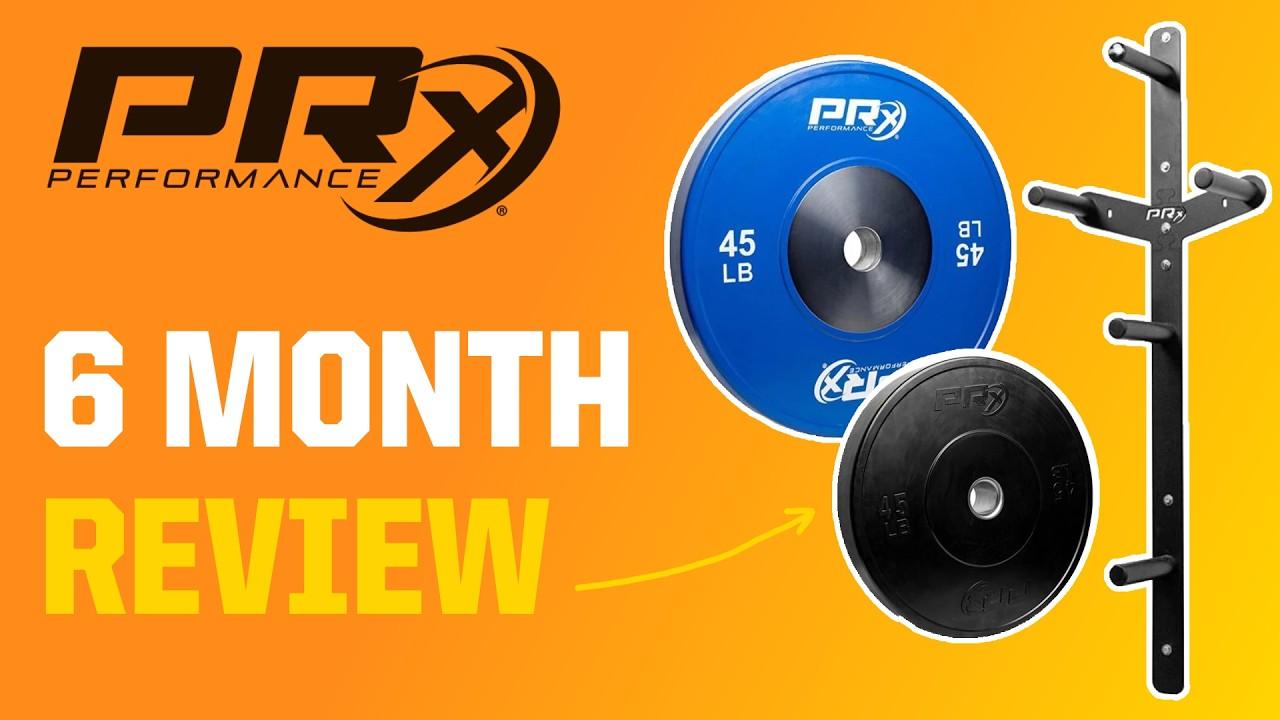
If you lift on a finished floor, buy bumpers, not iron. I love the competition plates because they're dense and thin and you get more weight on the bar, but the base plates surprised me, and they're enough for most people. Neither set shows wear or warping. The catch is PRx gives three different warranty answers on three different pages.
Buy it if
- Buy them if you lift on a finished floor, a vinyl floor or above a living space.
- Buy them if you drop the bar, or train alone and want the option.
- Buy the competition plates if you want the bar loaded thin.
- Buy the winged plate storage with them if you're done tripping over plates.
Skip it if
- Skip them if you lift on a garage slab and never drop the bar. Iron will save you money.
- Skip the competition plates if budget matters. They run about three times the price of the base plates per pair.
Photos
Pictures from the videos
Before you buy
What I don't love
Three warranty answers
The Prime page says 90 days on 10s and 15s and 2 years on the bigger plates. The site warranty page says 10 years. The Competition page says nothing. Get it in writing.
Prime specs are missing
The Prime line doesn't publish its insert material or rubber hardness, which are the two specs that separate a good bumper from a bad one.
Competition plates cost a lot more
A pair of competition 45s costs a lot more than a pair of Prime 45s. Check both before you decide.
Watch the videos
Every video I've made on it
Newest on top.
Base plates or competition?
Both PRx plate lines side by side after six months, plus the plate storage with the wings.
One month in
How the bumper plates held up after a month of use, and what I'd flag before you buy.
Day one
Unboxing the Elite and Prime bumper plates, getting it set up in my parents' home gym, and my first impressions.
Questions I get
What's the difference between Prime and Elite Competition?
Competition plates are denser and thinner for the same weight, with a published steel insert and 90 to 92 durometer rubber. The Prime plates are thicker and don't publish either.
Competition or base plates for a home gym?
Base plates are enough for most people. Buy competition if you want the bar loaded thin, or you just like them, which I do.
Will bumpers protect a basement floor?
That's the reason to buy them. Iron dropped on vinyl can crack it.
How much does the plate storage hold?
270 lb on the 3-peg and 360 lb on the 4-peg. The Weight Wing adds 50 lb per side for plates under 9.5 inches.
What's the warranty?
It depends which PRx page you read, which is the problem. Get it in writing before you order.
Specs
| Prime diameter | 17.75", solid rubber, 50.6 mm collar opening |
|---|---|
| Prime widths | 45 lb 3.18", 35 lb 2.59", 25 lb 2.00", 15 lb 1.37", 10 lb 0.90" |
| Prime sets | 160 lb and 260 lb |
| Competition plates | 450 mm, steel disc insert, 50.4 mm collar, 90 to 92 durometer |
| Competition widths | 25 lb 37 mm, 35 lb 47 mm, 45 lb 52 mm |
| Competition sets | 210 lb and 320 lb |
| Plate storage | 3-peg 270 lb, 4-peg 360 lb |
| Weight Wing | Plates under 9.5", 50 lb per side, 100 lb total |
From the blog
Related articles
More I've written that goes with this one.

The long version
My full PRx bumper plates review
Who these plates are for
I'm partial to bumper plates for a home gym. They're multi-purpose, and they help keep the floor from getting screwed up if you drop a weight.
Iron plates are harder on a floor. My dad has a vinyl floor down in his home gym, and dropping an iron plate on that could crack it. So if you're lifting on a finished floor, I'd buy bumpers and not iron.
If you're on a garage slab and you never drop the bar, iron will do the job and cost you less.
Where they are and what we got
These plates are in my parents' home gym, not mine. I set the gym up for my dad, and I lift on them when I'm over there.
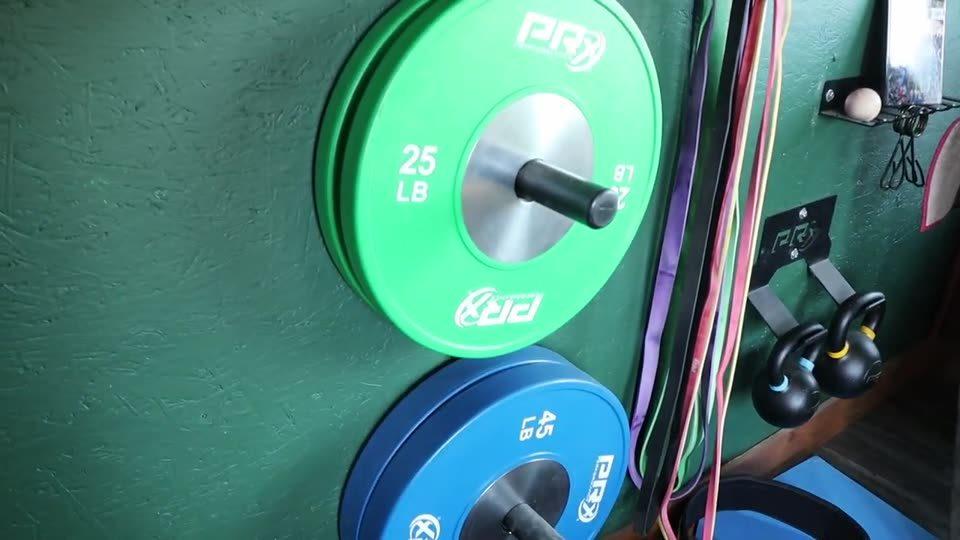
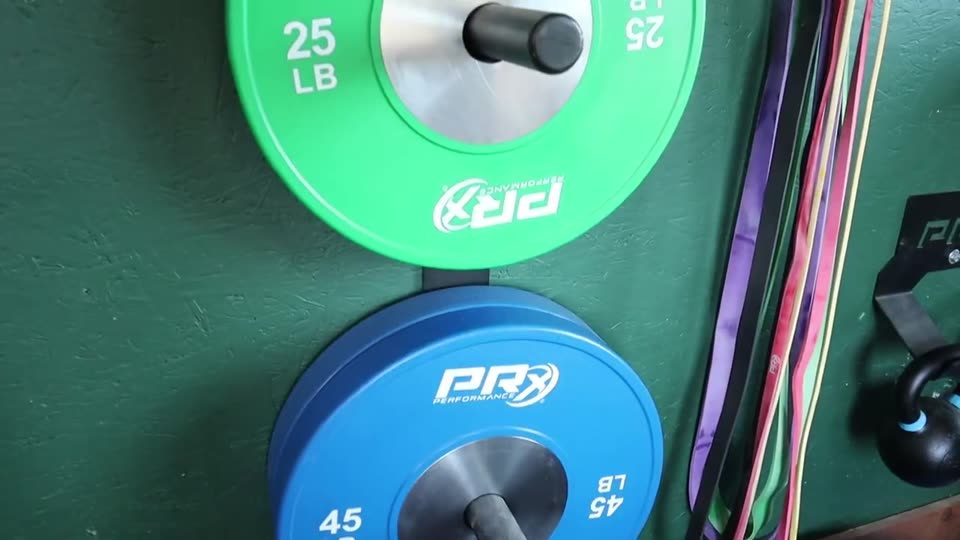
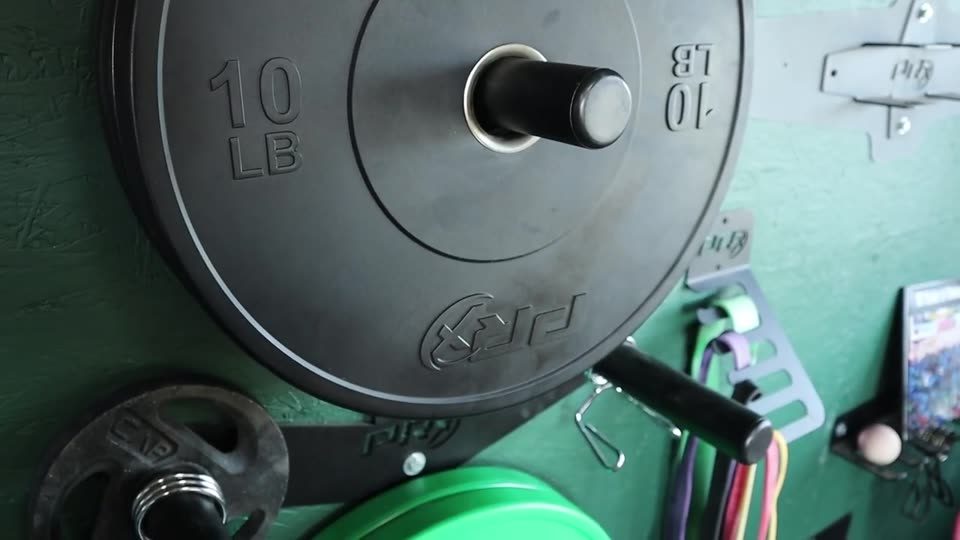
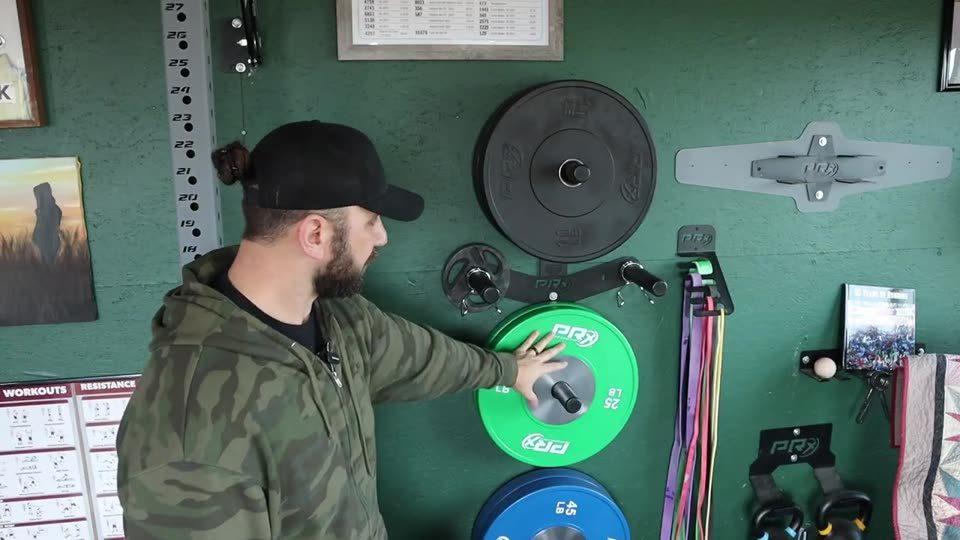
We got both kinds of PRx plates. The 10s and 15s are the Prime plates, which are their standard all-black bumpers. The 25s and 45s are the Elite Competition plates, green for the 25s and blue for the 45s. So I've been able to put the two lines side by side on the same bar.
The competition plates
I love these things so much. They're so dense and thin for the weight that they are. That thin profile is the point of a competition plate, because it lets you get more weight on the bar.
The tolerance is a lot tighter too. When I slid the 45s on the first time they didn't move around at all. They've got a steel disc insert in the middle, and you can tell right away it's a step up.
And when you drop the bar, there's no real bounce. I tested it on day one and again a month in, and the bounce is almost non-existent. If you do Olympic movements, that makes a big difference.
The base plates surprised me
The Prime plates are thicker, not as dense, and not as high quality as the competition ones. That's just what they are. They're still super solid.
There's a little more bounce with them, but not a crazy amount. They slide on with more play than the competition plates, so you're definitely going to want collars. Even so, they don't move around much once you're lifting. You don't feel like you're using cheap plates that aren't going to stay on the bar.
They're all weight at the end of the day. If you're just trying to lift, you probably don't need the competition plates. The base plates are a good, cost-effective set, and they're enough for most people.
How they've held up
In my six-month video I said I'd had them just over six months, and neither set showed any sign of wear. Nothing has warped.
That matters to me because I have cheaper plates at my own house that haven't held up as well. Some of my 10 pound plates at home have started to warp, because they're just not built as well. These haven't warped at all.
I expected to like the competition plates. I didn't expect to be this impressed with the base plates.
The numbers
The Prime plates are solid rubber and 17.75 inches across. The 45 is 3.18 inches wide, the 35 is 2.59, the 25 is 2 inches, the 15 is 1.37 and the 10 is 0.9. The collar opening is 50.6 mm.
The Elite Competition plates are 450 mm across with a steel disc insert and a 50.4 mm collar opening. The rubber is 90 to 92 durometer, which is on the harder side and is why they bounce less. The 45 is 52 mm wide, the 35 is 47 mm and the 25 is 37 mm.
One thing PRx says about the Prime plates: don't drop the 10s or 15s alone on the barbell. You can damage the inserts, and it voids the warranty.
The looks
I know they're just weights, but these look sharp. The all black is near and dear to my heart for a home gym, and the green and blue competition plates look freaking cool on the bar.
Aesthetics aren't going to make you lift heavier. But you kind of want to walk into a place that looks nice when you work out, and PRx pays attention to that.
Get the plate storage with them
The plate storage is probably the thing in my dad's gym I'm most jealous of. At my home gym all the plates are still on the floor.
His setup has three places to store plates, plus the wings for the smaller plates. PRx rates the 3-peg at 270 pounds. The Weight Wing takes plates under 9.5 inches and is rated for 50 pounds per side.
If you're doing the whole PRx home gym, I'd highly recommend getting the winged version.
The catches
The competition plates cost a lot more than the base plates. You pay a premium for the thin profile and the tight fit.
The warranty is confusing. When I checked, the Prime page said 90 days on the 10s and 15s and 2 years on the 25s, 35s and 45s. PRx's site-wide warranty page said 10 years on weight plates. The Competition page didn't say anything. If the warranty matters to you, get it in writing before you order.
PRx also doesn't publish the insert material or the rubber hardness on the Prime line the way it does on the competition plates. I'd like to see that fixed.
Which ones I'd buy
If you lift on a finished floor, buy bumpers. For most people the base plates are enough, and I'd buy them again without thinking twice.
I'd buy the competition plates if you want the bar loaded thin, or if you just like them. Which I do.
Monthly email
Get my latest reviews.
One email a month with every review I put out that month. Nothing else.